Friday, January 13, 2012

The Spirit-Letter Gradient

Everything--or nearly everything, anyway--has a grey area. Even something as seemingly straightforward as killing someone has grey areas, lest we forget about freak accidents or acts of self-defense. While some things I'll admit are pretty well objectively wrong no matter the circumstances--like discrimination against certain demographics based on factors beyond their control such as race or sex or orientation, or sexual assault of any kind, I really can't imagine any circumstance under which either of those would venture into a moral grey area--most rules and laws aren't going to apply exactly the same way to every situation every time. And treating all the differing circumstances exactly the same way and treating them to a one-size-fits-all solution is at best misguided and at worst could result in grievous miscarriages of justice. Which is why we dedicate an entire section of our government to the endless interpretation of every nuance of law. Not that they're doing a flawless job of it, just that the job has to be done.

A particular turn of phrase exists to describe this: the letter versus the spirit. It's entirely possible to bend the rules or slightly break laws as they are explicitly and literally written while remaining faithful to whatever intentions inspired their creation in the first place.

Whenever a police officer lets a driver go without a ticket for exceeding the speed limit by some small amount--five miles, let's say--he or she is following the spirit of the law while breaking the letter. Exceeding the speed limit by one mile is, strictly speaking, 'speeding' and you can absolutely get a ticket for doing it since it's against the law as the law is explicitly written. The reason this doesn't happen is because doing so doesn't violate the spirit in which the law was intended--speed limits aren't there to specifically dictate how fast drivers are to go, but rather to keep the roads as safe as possible. And excessive speed is dangerous--a car going too fast will have a harder time stopping, be more difficult to control, and in the event of a collision the force of impact will be exponentially intensified--but a difference of five miles isn't dangerous by itself if the driver is otherwise behaving in a safe and responsible manner and the conditions aren't hazardous. In this case, while the letter of the law has been broken, the spirit of it was not violated since the speed itself presented no danger.

Does that make sense?

At the same time, it's possible to do the exact opposite and strictly adhere to the literal interpretation of a law precisely as it's worded while at the same time completely and totally missing the big picture. Missing the forest for the trees, as it were. It's actually kinda hard to come up with a fictional scenario for this example that isn't wildly controversial in some way, so I'm just going to go ahead and tell my favourite 'Are You Fucking Serious?' story that happens to also be a perfect example of following the letter of the law exactly without grasping the spirit in which it was intended.

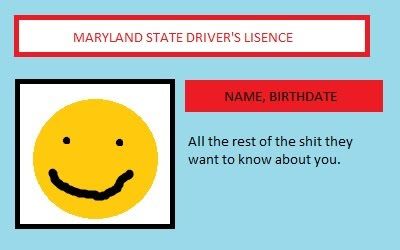
To start, you need some background information. In Maryland, where I moved from last year, driver's licenses were issued obviously and visibly different to drivers under 21 than to everybody else. If you are over 21 when the license is issued (or the first time you renew it after your 21st birthday), then your license is oriented horizontally, like this:


For everybody who is issued a license or renewal before the age of 21, it's oriented vertically, like this:
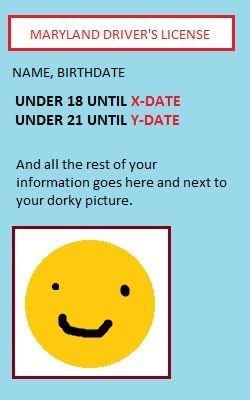


It's actually kind of a good idea, at least in theory--it's just one minor difference but it visibly separates potentially underage kids from everyone who can totally get shitfaced. (Unless they have a fake ID, of course, but that's neither here nor there.) Even handier for bouncers who can't do math, helpfully written in large bold red type on every under-21 license is the exact dates after which it is legal to sell them porn and cigarettes, and the date after which it is legal to sell them beer. You don't have to do any math at all--you just have to know what the date is. It couldn't be any simpler.

But at some point before my 21st birthday several years ago, the state of Maryland enacted a law that required anybody purchasing alcohol to have the horizontally-oriented 'normal' license rather than the vertical one--and possession of the vertical license barred you from being served alcohol even if you were over 21. I understand why this might have seemed like a good idea--I mean, maybe the people serving booze now are illiterate or legally blind or in some other way incapable of matching today's date with the 'UNDER 21 UNTIL' date and leaving them with no other option than to go by the way the license is printed.

Of course, I had no idea that this law existed--and neither did anybody else I asked about it--and since my birthday is in August and my license didn't need to be renewed until October, I didn't see any reason to subject myself to the MVA prematurely. So imagine my surprise when I went out to dinner to celebrate belatedly a week after my actual birthday and was told by the waitress that I couldn't legally drink until I got a new license. Even though I was 21 years and one week old. I was old enough to buy alcohol and I had the legitimate identification to prove it--serving me alcohol would not have been in any way against the law, except for the arbitrary fact that my license faced the wrong way.

This one is a pretty obvious case of following the law to the letter and missing the point entirely. The point is obviously to make it harder for anybody underage to obtain alcohol, but I wasn't underage and I wasn't doing (or trying to do) anything illegal. I just wanted a drink. In the end someone with the appropriate-looking license bought the drink and gave it to me, which in retrospect would probably have gotten us into some trouble but we were all so stunned by the 'WTF??'-factor of the whole business that we figured there was no way anybody would be able to charge us with any crimes because we weren't committing any. (Again, in hindsight I was on thin ice--drinking age is technically left up to each state to decide and I don't know how much or what kind of trouble I could have gotten into for obeying the state drinking law while breaking another state law that happened to contradict it. It's like the state legislature was dividing by zero or something.)

The point I'm trying to make here is that the real world is way more complicated than a straight 'yes-or-no' mentality allows for. A strict adherence to a law as written can technically criminalize something that isn't otherwise forbidden, and not every circumstance under which a law is broken also violates the laws of common sense that make up the big picture. A literal interpretation and immovable adherence to anything--law, religious text, advice, or whatever else you can think of--is a very unrealistic, immature, and problematic way of thinking and it has no place in a civilized world.

You shouldn't hit other people, but sometimes you have to defend yourself. You have to stop at red lights, but sometimes you're driving a woman in labour to a hospital. Breaking into someone else's home is never okay, except that your 84-year-old neighbour hasn't been seen since Monday and phone calls are going unanswered.

To be fair and civilized people, we have to accept that very few things are invariably right or invariably wrong. Black-and-white thinking might feel simpler and present the promise of invariable consistency that most people long for, but the reality is that 'right' and 'wrong' are luxuries we just can't afford anymore.

The Birth of a Cynic

When I told one of my oldest friends I had recently found a boyfriend, she thought this was hilarious because, quote, 'the Ice Queen let a boy be her boyfriend!'

She didn't mean anything bad by it--it was just her way of expressing surprise. I've been openly cynical about almost everything since I was a child, but the most scathing of it was concerning love and marriage and relationships. The ones around me--my parents and family members--were all so overwhelmingly dysfunctional that I was just disinclined to want to try it for myself. I didn't date at all in high school and very seldom in college, partially from a total lack of interest (both from me and in me) and partially because my realm of childhood experience didn't offer an especially positive or rosy perspective about romantic relationships. I'm aware that my perceptions are greatly skewed by the disproportionate concentration of really unhealthy relationships within my family, but it's really hard to shake off something as deeply ingrained as that cynicism. In fact I'm so cynical that I was only half joking when I suggested to my now-boyfriend before we got together that a perk of dating me would be having the best 'crazy ex-girlfriend' stories in any given group.

Yeah, in a single declaration I managed to be cynical about myself and romantic relationships. Not only did I straight-off assume that it would fail, but I also labelled myself 'crazy' and suggested that my only positive attribute would be derived from the unusual intensity of all my negative ones.

He still wanted to go out with me, though, so either he was really into me or my unregulated seratonin reuptake turns him on.

Anyway, I know why I think this way. On the whole I'm infuriatingly self-aware--I understand most of my serious problems very well and am capable of stepping back to look at them objectively to put them into a more realistic perspective. I even understand the basic steps I'd have to go through in order to resolve them, or at least lessen their overall impact on my life. I'm just way too lazy, unmotivated, and apathetic (all of which I understand completely) to want to do any of it. Like I said, it's infuriating. Well, infuriating to therapists and doctors and people who end up with an unwitting front row seat to my violent emotional instabilities. (It's not uncommon for me to undergo a complete shift in my demeanor within a 24-hour period between such massive extremes that I almost appear to be suffering multiple personalities.) I'm too apathetic to really be bothered by it. Which is actually a pretty bad thing.

But back to why I turned into a cynic about relationships.

My parents rarely got along and spent a lot of my childhood trying to overrule each other and then fighting about it. My mother is two-faced and manipulative and my father is emotionally distant and controlling. They bring out the worst in each other. They should have gotten divorced years ago. And I suspect the only reason they don't divorce (even now that my brother and I are grown and gone) is because they feel like they have to do better than their own parents did.

I never had an intact set of grandparents in my life--not because of death but because both sets divorced long before my parents even married. They actually all got divorced in the 70s, when such a thing was still pretty taboo. It says a lot about the depth of their mutual hatred that they were all willing to go through something as socially unacceptable as a divorce just to be rid of each other. My maternal grandfather had an affair and left for 'the other woman' (to whom he is still married). For most of my early years the wounds were still fairly fresh and I didn't see them together in the same place until I was about seven and my middle aunt got married. (And she only got them to do that by threatening not to invite either of them if they couldn't put their differences aside for the duration of one wedding.) The anger has since cooled and they're on decent terms, but there's a lot of noticeable tension in their voices when they talk to each other. Weirdly enough, my grandfather's wife and my grandmother actually get along quite well together. They told me it's because they compare notes about how obnoxious my grandfather is and I kind of believe it.

But at least they used to like each other, which is more than can be said for my dad's parents. They were from different cultural backgrounds (my grandfather was Italian, my grandmother mostly German, which is just as horrible as it sounds) and married at a time when you didn't associate with people not from your particular culture. Let alone marry them. And they did it just to piss their parents off and never liked one another at all. That dislike intensified with time to sheer hatred. My mom's parents can sit through a dinner together or attend a formal occasion without wanting to start throwing grenades, but I never in my life saw my paternal grandparents in the same room together. They never talked about each other. It was years before I realized that they even knew one another. (To be fair I was very young and didn't entirely understand what 'grandparent' meant in terms of familial relations.) When my grandfather died of cancer in 2004, my grandmother didn't attend the funeral. She didn't acknowledge it at all. Yeah, you have to have a pretty deep hatred for someone to do that.

(And it gets weirder. My grandma never remarried--neither she nor my maternal grandmother appears to ever have noticed that men existed after divorcing--but my dad's father was back in the dating pool. He was briefly married to a woman named Ellen, freakishly similar to his ex-wife Helen, who turned out to only be after his money. That marriage ended, too. For the seven years prior to his death, he had a long-term steady partner in a lady called Karen. Karen was herself divorced and before then had been a nun. You cannot make this shit up. My twice-divorced devoutly Catholic grandfather lived in sin for seven years with a former nun who was herself divorced. This is so fucked up it's funny.)

They aren't the only family members I have who married for the wrong reasons, either. My mom's dad's parents--my great-grandparents--were also from wildly different backgrounds. He was a dirt-poor Italian immigrant; she was from an obscenely wealthy family that owned theatres all over New York and frequently had movie stars over to dinner. I mean this woman was so rich she had servants growing up and having servants in America is a phenomena that's almost completely unknown. She was also Jewish. He was Roman Catholic. This was a big marital no-no back then. In fact it was such a big no-no that her family disowned her. She never saw them again and died in near poverty in a Brooklyn tenement. I wish I could say that she gladly suffered all this because of her love for the man she married, but the truth is that she only married him because it was the early twentieth century and pretty much the only way an upper-class Jewish girl could rebel against her family would be to marry someone they didn't like. Which appears to be exactly why she did it. It didn't bring anybody involved any happiness.

There's more, too.

I have one uncle who's a recovered drug addict and married a pretty young Irish lady who turns out to have only been after US citizenship. My youngest aunt spent years with a man who beat her. Another of my aunts was bullied and manipulated cruelly into having children she never wanted (and still doesn't love) in order to meet his standards.

And this is just the shit people talk about. I'll bet my left tit there's much more--and probably worse--that's just swept under the rug and not discussed.

Such a concentration of totally dysfunctional relationships doesn't happen in the general population. It just appears that my family has more than their share and that some of them are real doozies. My childhood wasn't confined to family alone, of course, and I had experience with other people's families that were much more normal than mine was, but in the end the shit happening all over my various familial branches coloured my perceptions the most.

It's no wonder I'm a cynic.

Wednesday, January 11, 2012

Fashionably Impractical

Grown women have no business wearing rompers. (Or bodysuits or jumpsuits or one-pieces or whatever the fuck you call these things.) No one out of diapers should be wearing them. It's like feetie pajamas--they only ever look okay on kids and adults wearing them borders on creepy.

Never mind that they look awful. Never mind that they turn you into a solid and formless block of colour or pattern. Never mind that nobody comes close to looking okay in one unless they're really tall and really skinny, which almost nobody is. Never mind that they make you look short-waisted and short-legged, even if you are tall and skinny. Never mind that having a torso even slightly longer or shorter than clothing manufacturers thought you would have means it will drag at your shoulders and ride up your crotch and ass all at the same time.

Let's just focus on their major shortcoming: they're not practical.


Remember the 90s and early 2000s? Overalls were back in style. Casualness that bordered on aesthetically reckless was totally cool. Except that no one looks good in overalls for the same reasons nobody looks good in a romper. And worse, too, because they were loose-fitting all over and were a solid mass of a single colour. They also suffer the same major shortcoming in terms of their practicality, which is that you have to plan pretty far in advance when you need to use the toilet. I don't like having to almost completely undress when I have to go. It makes me feel exposed and if you happen to have some kind of urgent digestive or urinary need, things could end badly for you. I had a pair of overalls when they were popular and quickly discovered this problem, which was a sufficiently big one to put me off of wearing a one-piece anything ever again. A subheading under this category is that you have to hold all the discarded fabric up unless you want to contract bubonic plague or something from a dirty bathroom floor that hasn't seen a mop since before you were born.

I don't know if you would have to hold a romper up off the floor, but you still have to take all your clothes off. Speaking for myself, if I need to pee I gradually lose control of all my faculties one by one until I can relieve myself and my fine motor skills always go first. Not really an ideal situation to be in when you have to hold it while you negotiate buckles and buttons. It's the nature of fashion trends to be cumbersome and impractical, a carryover from a time at which wearing certain kinds of clothing was a status symbol based not on their cost but on the fact that they prevented you from easily doing all but the simplest of tasks for yourself. It was a way of showing--or at least giving the impression--that you could afford not to do any work.

People just need to stop wearing them. If you are not a farmer or a mechanic or an extra in a movie set during the Great Depression, you have no excuse for wearing one. Even with all their embellishments and cut to a better fit, it still amounts to wearing clothes associated with infants. Which is actually pretty weird at best and at worst really, really creepy-looking.

Just, stop. For the love of small fluffy kittens, please stop wearing them. You look terrible dressed that way.

Also, while looking for a picture of adult rompers to post here, I noticed that all the top hits were from people talking about why rompers suck and shouldn't be worn.

I guess on the plus side it means I'm hardly the only person to hate them this much.

When to Overreact

Sometimes people just have totally inappropriate reactions to things that happen to them. Mostly you read about excessive acts of revenge or overreactions. Like killing someone over Facebook comments. That’s an overreaction. So is dealing with a bad breakup by driving a car through your ex’s house. We’re all entitled to emotional reactions but murder and enough car and property damage to put two insurance companies out of business are at the very least out of proportion with the events that triggered them. As well as being really illegal. Sometimes you just can’t help it and you get a bit emotionally charged and not entirely rational. The day you’re late for work because you had to peel two miles of frozen wet wads of toilet paper off of your car and the tree next to it is the day you start believing in capital punishment.

Less commonly, you hear about people who have the most surprisingly relaxed reactions to things for which it would kind of be totally understandable to retaliate by shooting someone. Sometimes you can explain it by the relief being greater than the annoyance and frustration. Other times an underreaction is just as unbelievable as an overreaction.


For example, waking up to find your dog barking like crazy because there’s a crocodile in the house. Any reaction you decide to have to this would be completely appropriate. In a situation like that there is no overreaction. But you can still have a totally inappropriate one, as was the case in Darwin, Australia when one couple woke in the middle of the night to find a five and a half foot salt-water crocodile in the middle of their living room. And it was pissed off.


I understand getting bugs in the house. Small rodents. The occasional bird. If you’re unlucky enough you might have a squirrel or raccoon problem. Those things get into houses all the time because they’re nimble and sneaky or at least fast enough to get inside when you go to let the cat in.


Crocodiles are not something you really think of in this capacity. They can’t open doors or climb through windows and they’re not small enough to fit through holes in the insulation or dog-doors, so finding one in the house isn’t something you can really prepare yourself for. Not that this really matters when you come downstairs and there’s a fucking crocodile under the coffee table and it’s hissing mad at you.


Whatever you do in response to this situation would be acceptable.


For some reason, this Australian couple decided the best reaction would be for the husband to fend it off by hitting it with his guitar while the woman called the crocodile removal people.


First of all, the urgency of the situation allows you to turn whatever is handy into a weapon. I just don’t think a guitar is the best choice and it might be a good idea to spend a few seconds looking for something else. If for no other reason than because getting close enough to hit a crocodile with a guitar would also put you close enough to find yourself on the business end of a very nasty bite.


Secondly, apparently finding crocodiles in places they have no business being is a common enough occurrence in Darwin that they have a specific group dedicated to dealing with it. She didn’t call animal control. She didn’t call the ‘unwanted and inconvenient intrusion of wildlife’ people. Not even ‘dangerous animal incursion’ people. She called the Crocodile Removal Unit whose job it is to remove crocodiles. Such an organization would probably not exist were it not for some level of necessity. Who knows, maybe a crocodile infestation is the Australian equivalent of an ant infestation or something.


So right away we have the unexpected presence of a crocodile in the house, the inappropriate choice of defense weapon, and the mindfuck inherent in there needing to be crocodile disposal people in Darwin. Already we’re dealing with a Salvador Dali level of the surreal. And then you have this lovely quotation from the news interview with the woman in question, which is the only opinion there seems to be of the whole business:


“It is pretty full-on.”


You would be justified wanting to flee the country if this happened to you. Maybe seeking a less reptile-intensive environment, like Siberia. Instead it’s described as ‘full-on’ and nothing more. In American it’s the same as saying it was ‘a little much’. I don’t know anyone who could keep that calm about an unwanted moth in the house. A power outage is ‘a bit full-on’. A major appliance breakdown is ‘a bit full-on’. The presence of a large deadly reptile in a bad mood is a problem.


And yet no one involved seems to be at all concerned about this. That it attracted enough attention to be newsworthy means it’s at least a little unusual, but doesn’t appear to be attracting any more attention than local news would pay to a shoplifter.


If there’s ever a situation that causes Australians to panic, I suspect the rest of the world will be totally fucked.

Sizing Up

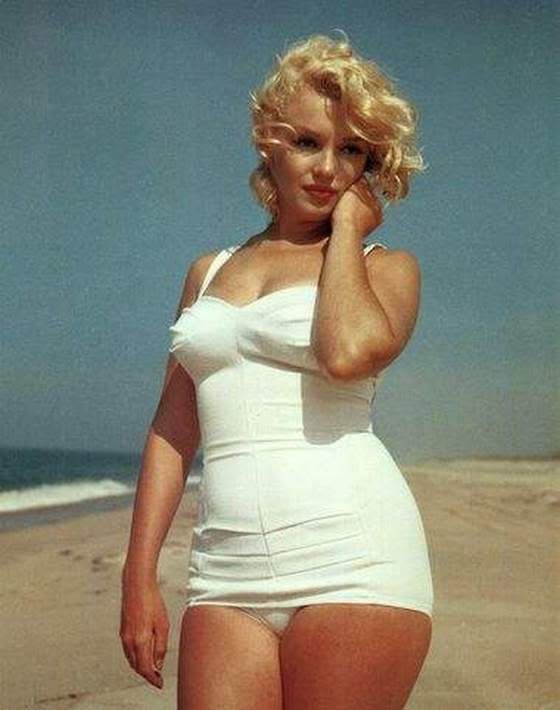
This is Norma Jean Baker. You know her as one of the most famous sex symbols in movie history, Marilyn Monroe.


Whatever you personally feel about her or her work, we can all agree that she did an awful lot over the course of her career. It spanned less than fifteen years and her life was tragically cut off at 34 from a combination of mental illness and substance abuse. She died alone from an overdose of sleeping pills a virtual recluse, a sad ending to a life that was mostly very hard on her. In that very short space of time, she rose to rapid super-stardom and became Hollywood's biggest and most popular leading lady. She was also much, much more intelligent than the 'dumb blonde' she always played. She was a movie star, a model, a cultural icon, married and divorced several times, and a singer among rather a lot else.

Yes, Marilyn Monroe was a lot of things.

One thing she wasn't was a size sixteen.

It doesn't require more than the most casual glance to see that this supposed 'fact' doesn't have a lot to go on. Sometimes you kind of have to wonder if the people repeating it religiously have ever seen a photo of her. Even accounting for the fact that the dimensions of women's commercial numbered clothing sizes have changed over the years, this myth is still not true. The claims are either that she was equal to a modern size sixteen, or that she wore a sixteen in her own time and that translates to a different size today. And the difference is just one or two sizes, so it would still be equivalent to a twelve or fourteen. Semi-related: I've never been able to figure out why sizes are numbered the way they are. Men's sizes are done by waist x inseam, which is a way more practical method than arbitrarily assigning numbers--and children's sizes include all the numbers. Adult women's sizes, for some reason, are assigned increasing even numbers and adolescent girl sizes are assigned odd ones. None of which are consistent from one brand to another.

Anyway, what it comes down to is that Marilyn in no way looks like a size sixteen by anybody's standards. So either hundreds of photographs, movies, and production stills are pulling off a massive optical illusion (better than your best deceptive Facebook angles), or someone somewhere pulled this 'fact' out of their ass and it isn't true.

I understand why people repeat it and I understand why people want it to be true--confronted with an impossible and unattainable body-image standard, there's a lot of vindication and comfort in the idea that one of the greatest sex symbols of any age would, by modern standards, be considered plus-sized or even 'fat'. It makes us feel way better about ourselves.

But it isn't true.

Marilyn Monroe definitely wasn't a stick-person. (Your average model or actress today is a size two and rarely more than a size four.) Even in her own time she wasn't typical--then as now, actresses tended to be taller and thinner than the norm (think Audrey Hepburn), and Marilyn wasn't even five and a half foot tall with more curves than Lombard Street. It's hard to say what size she would have taken in her own day when she browsed the racks at Bloomingdale's since her famous dresses and costumes were all custom-fitted. But this is kind of a good thing, because if she bought all her clothes off the rack according to their numbered sizes, it would have been almost impossible to adequately dispel this myth. Sizes vary pretty dramatically from one brand to another and even sometimes within the same brands--just for a comparison, I wear a size six or eight most of the time but I own jeans that fit me perfectly as small as a size four and as big as a size ten because they were made by different manufacturers. Most of them are the same brand, too. So even if Marilyn bought size two jeans, that doesn't really tell us anything about her actual size.

Fortunately, her clothes were mostly tailor-made so dressmakers and studios had her measurements on file and still do. Because of her popularity, her iconic dresses (the pink form-fitting number from 'Gentlemen Prefer Blondes' and the infamous Subway Dress, for example) survive in museums and private collections and are easily measured. Rather than just unhelpfully saying she was size-X, we know what her dimensions actually were.

So what were they?

During her glory days in the 50s, her measurements were between 37-23-36 and 35-22-35.

First observation: that is a stupefyingly narrow waist. I'm normally called an 'hourglass' and my waist is 27. I think each of my thighs is 22 inches around. Her hips were pretty small, as well.

Second observation: she had some boobs there, didn't she?? Big busts are kind of the norm now but it's safe to say a good many of them are enhanced in some way with either a padded bra or surgery. (Very few people as rail-thin as modern models and actresses have enough body fat to have really big breasts like that.) Hers were an all-natural D-cup.

Third observation: there is absolutely, positively no way in hell anybody made clothes so small that those measurements counted as a sixteen. At the risk of offering a little too much information and sounding smug (which I'm not--I just want to prove a point), I wear either a six or an eight which, however I see it, isn't 'plus sized' and is actually smaller than average. (Average in the US is a size twelve.) My measurements are: 36-27-40. Except for her boobs, Marilyn was smaller than me and you can still get two of me into a typical size sixteen. I have no idea what I would have been by the smaller sizes of the 1950s, but I still wouldn't have been a sixteen. And if I'm not, then she definitely wasn't.

(And just for shits and giggles, the slender and willowy Audrey Hepburn's measurements were 34-20-34 and she was 5'7". She purportedly never weighed more than 105 pounds. Goddamn dancer physique.)

As I said, the differences in sizes makes it really hard to say for sure what measurements equal what sizes. Going by the size chart from Old Navy (for no other reason than because I happen to work there and that's where most of my jeans come from since they sell them in lengths and I have a really short inseam), her waist and hip measurements would let her comfortably fit into their size four. If she was picking out a dress and had to accommodate her bust, she would need a six. Much more than your standard-issue commercial or fashion model, but still nowhere near the sixteen dictated by this extremely pervasive myth.

It'll vary, of course, but it still comes down to this: Marilyn Monroe was equal to a modern size four or six.

She withdrew from the spotlight in the late 50s and didn't appear in any movies after 1960 (her last was released in 1961 but filmed a year earlier), after which she did gain weight, but the coroner's report from her autopsy lists her weight as 125 pounds. Even the most liberal distribution of that weight isn't very big. Again, I outweigh her by a good fifty pounds (of which almost none is muscle) and I'm still not a size sixteen. She was unlikely to have measured more than a modern size eight.

A quick and unsubstantiated guess as to what all this equaled when she was alive and wearing all those fabulous clothes is most likely between a six and a ten. I tried looking it up and found numbers as small as a six and as big as a twelve, but six and ten is probably the most likely range for her day.

I know why we so badly want this to be true and repeat it like gospel. 'Marilyn Monroe was plus-sized!' as an argument is guaranteed to pop up in any real-world or internet forum discussion on female beauty standards. Otherwise respectable and intelligent people--including several of my teachers and feminist professor Gina Barreca--have stated it as fact. Because, goddammit, if a size sixteen was good enough for the quintessential blonde bombshell then it's good enough for me! But simply saying it doesn't make it true.

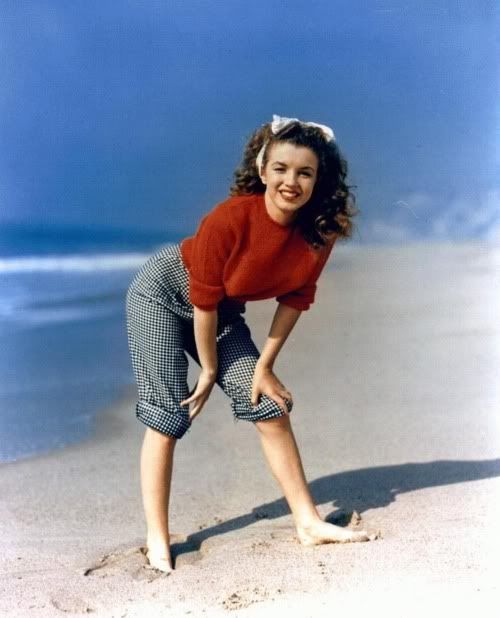
Incidentally, she also wasn't a natural blonde. She was brunette. That signature platinum bob was the result of a lot of peroxide and she didn't start dying it until she began acting in movies--supposedly she did live with an aunt when she was eight who bleached her hair and made her wear all white, but I don't know whether or not this is true so I'm not going to state it as fact. Photos of her as old as her early twenties (the late 40s) have her with her natural hair colour--the blonde was just more commercial at the time and you kind of have to admit it suits her more.


I don't know when this was taken but she doesn't look as though she could be much older than about eighteen. She was still gorgeous as a brunette but ultimately the effect is completely different with that curly brown hair and the bow. It might be bias or it might be that the default image of her is as a blonde, but it's hard to picture her standing over a subway vent looking like this. The curls, the bow, the baby-face, and the dimples send her Cuteness Factor through the roof but she almost looks too wholesome to be a sex symbol.

And she isn't a sixteen here, either.

My position isn't one of ignorance. I'm not one of the very small number of lucky women who effortlessly and seamlessly comply with the standards of female attractiveness. You can certainly influence--but not entirely control--your weight and body fat content with a carefully regulated diet and regular exercise, but like height your body type is determined largely by genetic factors beyond your control. Barring doing something extreme, you aren't going to be rail-thin if you're not programmed that way. And I'm definitely not. I'm among the 95% or so of the female population with a different body type than that impossibly tall and skinny one. I'm pretty substantially overweight, especially for my height (I'm five foot), and at no point in my adult life have I been less than 120 pounds which still medically qualifies as being overweight. I currently weigh about 170 or so, which puts me comfortably in the range of obesity, and as I stated, my measurements aren't unrealistically tiny.

However badly we want to be able to dispute what we mostly accept anyway--that such exacting standards are unfair and unattainable--you can't do that by repeating a myth. Marilyn was certainly no stick-person but neither was she plus-sized.

But it doesn't matter. None of this does. Whether Marilyn Monroe was a six or a sixteen, she was still beautiful. In the end, the arbitrary number assigned to her and Audrey and Angelina and all the other icons of our or any other age don't matter. You're beautiful, too, in your own way, and it has nothing to do with the number on the tag in your jeans.

It's nice to feel good about yourself. It's nice to see your own attributes and to be comfortable with yourself. It's healthy. It's realistic. It'll probably make you a lot happier.

But Marilyn Monroe doesn't have to have been a size sixteen in order for you to do it.

Tuesday, January 10, 2012

problem?

Sometimes I feel like I'm a magnet for moderate recurring medical problems that are disruptive and very uncomfortable but that defy diagnosis and treatments. I've finally gotten a mysterious fifteen-year coughing fit under control with an asthma inhaler (even though it isn't asthma) but no doctor in all that time has ever been able to say what it actually is or what causes it and the inhaler is just suppressing the symptom without treating the problem. I had as many diagnoses as I had doctors and they ranged from bronchitis to pneumonia to whooping cough to accusations of faking it (I have no idea how that made sense). After fifteen years I'll take what I can get but it's still frustrating and worrisome to have such an obvious problem for which there is no answer.

Since I have that out of the way another peripheral problem has flared and become way more problematic. My knees are killing me. I mean I am in more pain than I can physically tolerate and I've run out of things to try to alleviate it. There isn't any obvious cause--I'm not an athlete and haven't injured them and I've been checked for arthritis--but that doesn't make it less of a problem. It kind of makes it more of a problem. Reporting to a doctor for mysterious joint pain that leaves no physical signs, doesn't cause limping, and has no immediately apparent cause looks extremely suspicious and I've since stopped trying to get medical attention for it after being flagrantly accused of faking it for drugs. (The irony is that I have a drug problem--I accept that, but I don't like being accused of it. It's against my principles to abuse urgent care clinics or emergency rooms for that. If I go to a place like that, it's because something is wrong.) I don't completely blame anyone for doubting me, though. The symptoms are completely mystifying.

I can walk just fine and my knees don't lock or give out like they would if I had an injury. Weirdly, the pain is slightly relieved by being on my feet instead of sitting or laying down. Something about the weight or compression makes the pain a little less intolerable, though not by much. Of course, the fact that weight helps with the pain eliminates the only potential cause of it I can think of, which is that my joints can't cope with the insane amount of weight I put on them. I'm pretty significantly overweight and knee pain is often synonymous with that, but if that were the case I would be in pain all the time and I doubt being on my feet would do anything but make it worse.

Most of the time I'm not bothered at all. It's not even like the pain is negligible or less noticeable--it just plain isn't there. (Which also flies in the face of any conventional diagnosis because an injury or strain or joint disorder would hurt all the time.) But when it flares up, it makes itself noticed. Out of nowhere for no reason my knees will start to ache, which then quickly escalates to constant pain so bad it sometimes makes me throw up. (The only other kinds of pain that do this to me are migraines and kidney stones, for the record.) It isn't even an obvious place to be in pain, like the kneecap; it's in the squishy part just below it, where I'm reasonably sure the joint fluid is. For lack of a better descriptive term, it sort of feels like that sharp ache you get when it's really cold outside and your joints seize up and hurt, but way worse and it won't stop.

Normal methods of pain relief are ineffective or make things worse. Everyone and their mother says you should put ice on muscle or joint pain, but doing this intensifies the pain until I'm in tears and I refuse to do it anymore. There's absolutely no way it was doing any good and it kind of seems like a case of the treatment being worse than the disease. A heating pad helps a little bit, but it only lasts as long as I keep it on my knees and doesn't make more than an incidental difference anyway. There's no favourable position that's more comfortable or hurts any less, no elevation or angle of the leg, so finding a tolerable way of sitting or sleeping is impossible. Even the most powerful painkillers I can get don't make them stop hurting.

The one thing I can do that sometimes offers a little relief is to firmly--probably dangerously firmly--compress both knees completely. Based on the fact that standing up and having all my weight on my knees is less uncomfortable, I tried squeezing one out of sheer desperation and after holding it for a while it actually began to hurt a tiny bit less. Enough to make it worth my time to keep doing it, at any rate. I tie a blanket or towel very tightly around each and after an hour or so it lets up a little bit. Of course, then I have something tied around my legs and I don't really like that, but it's the lesser of two evils. It doesn't cut off my circulation, but I still can't imagine it's very good for me. I'm just really, really desperate.

Otherwise I am completely out of ideas. Even the Almighty Google doesn't offer and helpful answers and none of its suggestions seem close enough to be a step in the right direction. The only outward sign that anything is going wrong is that the fleshy parts of my knees swell, even though it doesn't hurt or bother me at all to prod at them.

I accept that the weird symptoms and random nature of the problem make it hard to even believe it exists. That's what makes it so frustrating. Nobody is inclined to believe it's real because it makes no sense at all and frustration at being accused of lying makes me reluctant to go back to the doctor for it. I'll just leave frustrated and embarrassed and won't get any answers anyway.

I don't know what else to try and am once again left to deal with a problem that interferes with my daily life but that I can't even identify. Even in the event I find some relief or the latest rounds of torment are over, it still doesn't actually solve my problem.

Which I hate.

Sitting Pretty

When I can find the work, I freelance as a model.

The unlikelihood of this fact is hard to stress without showing a photograph or otherwise betraying what I look like, but suffice to say I am pretty well the polar opposite of conventional mainstream professional models. I’m twelve inches too short and fifty pounds too heavy and haven’t a glamorous bone in my body. I’m not even like one of those curvy modern pinup models who, despite not having the typical ‘model’ body type, have a certain appeal by the way they more or less radiate confidence. Their comfort in their own skin gives them a powerful sex appeal that defies the skewed body-image of popular culture. (Fun fact: 95% of fashion models have that tall, low-body-fat, willowy figure that really occurs in less than 5% of the Western female population.)

But I am not one of these women. I haven’t got an ounce of self-confidence and my self-image is pretty shitty. (The only feature I consistently like about myself is my eyes. Everything else is subject to ruthless self-depreciation.) I'm excessively concerned with how I look compared with women I find attractive, who are not, incidentally, the willowy tall model types and actually much closer to my own body type. I wouldn't call myself vain, but my level of obsessive paranoia borders on complete neurosis. I've also got a rather rampagingly obvious body dysmorphic disorder going on because I am insanely attracted to women with a body type identical to mine and can't find a single thing about them not to like, but see nothing but faults in myself. It's only when it's on me that an otherwise appealing trait becomes unattractive. I'm perfectly aware of the dissonance but I'm still in the position of being put off by my own body but helplessly smitten with women who look exactly like me. As far as indicators of body dysmorphism go, there could not possibly be a bigger red flag waving around. All that can be said in my favour is that I'm well aware of what's going on and am usually able to stop it from getting totally out of hand. (In other words, the condition is severe enough that I hate my body but I'm aware of it enough to know it's all in my head and not do anything drastic about it.)

So I’m not the natural first choice as a model. But I do it anyway and enjoy it immensely when I can find the work, even though I’m aware I basically represent a very small niche appeal demographic. I actually have a better opinion of myself in photos than I do in the mirror, even though I know there’s no actual logic behind thinking this way. I attribute it to a combination of flattering but deceptive camera angles and superfluous post-editing. As well as not being generally inclined to making a lot of sense.

I manage to conceal my poor self-image quite well. I trick everybody from makeup artists to viewers into believing that I’m much more comfortable with myself than I actually am by surprisingly effectively pretending to have way more self-confidence than I really do. It’s an act—a good one, but still an act. Nothing could be further from the truth. I’m basically a 200-pound bag of insecurity and body-image issues with an inexplicable fondness for sitting in front of a camera. I’ll even pose nude with an apparent ease and nonchalance that is entirely incongruous with the way I view myself.

I imagine it’s a fortuitous of a lack of studio mirrors and the promise of a paycheck. My tolerance threshold skyrockets if I know I’m going to get paid for it—which is how I manage to work where I do for a day-job without killing anybody. I’m not saying it’s very healthy (it kind of makes me sound a bit like a hooker, thinking about it), I’m just saying that’s kind of how it works.

Even without the burden of a non-commercial body type and a very dim view of myself, I’m still not the obvious first choice for a model. The foremost problem is that I’m physically awkward and so badly uncoordinated that total strangers often think I’m drunk or have an inner ear disorder. This is hard enough to accommodate day-to-day—in the confined space of a studio with hazards like backdrops, props, and lights and under the watchful eye of thousands of dollars in camera equipment, it’s a large insurance claim waiting to happen. Heaven forbid I have to sit on a chair or a dais or something. High heels are a perennial hazard and keeping track of all four of my limbs and my surroundings and the camera is just a little short of rocket science. Really, I might as well save everybody the time and energy by giving myself two black eyes and then driving home.

I’m also not completely comfortable wearing makeup. Well, I am now but I didn’t start wearing it until I was in my 20s so I lack the general familiarity and comfort with it that most women my age have. If I didn’t spend my spare time sitting in front of cameras this wouldn’t be an issue, but most studio gigs require makeup and I’m unhelpfully ill-at-ease wearing it because I’m so unused to it.

Part of the problem is the sheer amount slathered on. Those studio lights are unforgiving and to show up on camera requires a lot of makeup. It’s applied as thick as spackle and not a great deal easier to wear. It requires layers and layers of application and I can feel the weight of every brushstroke on my face. I constantly have to be reminded not to rub my face, and when I inevitably forget not to I annoy everyone by having to stop everything to be touched up. If I have to wear false eyelashes, forget it. (Lucky for me my eyelashes are quite long and show up easily on camera, so I don’t need them very often.) I don’t know how women wear those as a matter of routine—it’s impossible to ignore them. And I’ve only worn the ones that are the same length as my real lashes. If I had to wear those super-long Lady Gaga (or drag queen) eyelashes, I’d probably just scratch my eyelids right off. They’re the first things to go as soon as I get the okay to remove the makeup.

Because I have to wear way more makeup than I’m used to wearing on my own, I can’t do it myself and have to sit for a professional for much longer than I can easily tolerate. I’m a twitchy, fidgety person most of the time anyway so it’s asking a lot for me to sit still while someone paints me like a pantomime dame. And because I have to force myself to sit still, I end up thinking about it, and thinking about it makes it harder to sit still. I usually end up twitching like I have freaking Tourette’s and the whole process takes twice as long as it should. Quite understandably, makeup artists don’t like me very much.

Despite all this, I still take gigs wherever I can and have fun doing it. Once in front of the camera I feel quite natural and chatty so everybody quickly forgets that I’m playing against type, am a bodily risk to the studio, and took over an hour to make up.

So I get to have some fun, get a little confidence boost, and get paid all in the same afternoon. I get a lot more input at my shoots than is customary mostly because I’m not a standard model and there isn’t a mainstream audience to appease or an ‘image’ to maintain. Because I’m not normal, nothing about the finished product has to be a certain way so it’s okay to do much more experimenting than would otherwise be allowed. Which is what makes it enjoyable. If I had to play by someone else’s rules, I doubt I’d like it as much.

My crippling self-consciousness doesn’t show through in pictures, and thank goodness for that because a model intensely preoccupied with her the size of her thighs isn’t an attractive image. Actually, I’m not sure if appearing so comfortable in my own skin is a charade or if it’s the genuine result of temporarily—briefly—managing to shed all of my hangups.

Either way, there’s something strangely and gratifyingly liberating about being able to make myself appear in a much different light than I do in the real world. Sometimes I think that if it comes so easily to me in front of the camera, then maybe it’s possible to do it for real.

But hey, one step at a time.

I’m still not used to wearing the false lashes yet. An entirely new self-image will take a few fittings.