The universe is enormous.
I mean it is unbelievably, unfathomably vast. I know I lessen the impact of those words by employing them hyperbolically all the time but in this instance I'm not only being completely serious, it's actually understating matters. The universe we represent the tiniest and most inconsequential speck of is enormous in ways that mere words have no power to adequately describe. It is so big and we are so tiny that to even call it 'our' universe is almost arrogant. It isn't 'ours'. We just live in it. If anything, we belong to it.
The universe is old, too. Not just ancient, but so old it makes 'ancient' look pre-pubescent. We can only estimate how old it might be and we do that by calculating the space between us and the dimmest, most far-reflected scraps of light. Even based on this the answer isn't consistently agreed-upon and differs from eleven billion years to sixteen billion years depending on who you ask. Either way it is many times older than Earth--indeed many times older than our galaxy. And that's just what we think we know; there's every chance, in fact a pretty damn good chance, that it's even older than that and that we just can't perceive it any further. 'Old' doesn't even begin to cover it.
And it's empty. Really empty. The stars look innumerable, and those are just the ones we can see, but they're spread out over an enormous area. The distance from one floating hunk of rock or gas to another is similarly massive beyond reckoning. Even within our own solar system--effectively our own neighbourhood--the distance is so big it takes years to traverse even the smallest. We still can't reach all the way to the edge of it, and that's locally. Forget going from one galaxy to another--we can't even get out of our own solar system. And no matter how hopeful so-called 'UFO-logists' are, it's unlikely anyone or anything else ever has, or ever will.
All we can do is look up in awe, the scope of our understanding too limited to really meaningfully comprehend just what we're seeing. We're not even a cosmic speck of dust. We're a proton in an atom in a cosmic speck of dust. We are so inconsequential it makes us nervous to think about it, so we like to pretend this isn't the case.
People who like to deny the modern interpretations of cosmology, geology, and biology that make up the story of us point to these facts as a way to deny the natural processes behind our existence. The odds stacked against it all are too big to have been overcome naturally. So we must be the product of a divine will, a being and intelligence far beyond our understanding. Somehow it's easier to think we're the fleshy Legos of a god, rather than the result of unlikely but entirely natural events.
Make no mistake: that we are here at all is the result of defying incredible odds. Absolutely nothing about us or our existence is in any way inevitable. Our galaxy and solar system were formed in just the right circumstances, our location within the universe in just, the conditions of our planet within just the best range so as to allow life to form. Or rather, to allow life as we know it to form. That's the key term, and one a lot of people overlook--as we know it. Life as we know it is actually pretty startlingly limited. Life and intelligence under a completely different set of parameters, that we can't even begin to grasp an understanding of, could exist anywhere without us knowing because we just don't know the criteria to search for.
We as humans aren't very comfortable with all this, which is why we gravitate to the intelligent design angle more than we accept a natural explanation. With such a narrow scope of comprehension for the universe around us, denial is easier than research. If we were created, then we're special--instead of just being that cosmic proton that makes us so uncomfortable.
But no, we're not special. At least not like that we're not. But just because nobody and nothing 'poofed' us into existence on special order doesn't mean we can't be cherished. As I said, our existence is in and of itself incomprehensibly unlikely. That our planet is hospitable to life as we know it is impossible enough as it is--even on a much smaller scale, our very evolution, wasn't inevitable. Things could have, and very nearly did, go completely differently at any time. Circumstances could have changed and the development of a single upright-walking, big-brained primate could have gone another way completely.
This is rather insulting to quite a lot of people, on the theory that defying cosmic odds is way less cool than being put here on purpose. On the whole, though, I think it stems from insecurity rather than any actual offensiveness inherent in being natural creatures. The words 'chance' and 'luck' are bandied around with something like violent hatred in these arguments. Scientists are quick to correct such statements by saying that randomness and luck have nothing to do with it, but again: nothing was inevitable. It still isn't.
I don't find any of this upsetting or insulting at all. To the contrary, I think it's amazing. That so much of our existence is so very fragile doesn't detract from our worth but adds to it. Far from computers, or penicillin, or the printing press, or written language, the greatest achievement in the history of mankind is that we're even here at all--and that here we stay.
And the fact that it is all so very delicate is beautiful. The fact is that we are not special. At any point in the history of our planet things could have gone differently, with far-reaching effects. That everything we know came so very close to being so very, very different--or not existing at all--only makes it clear how beautiful and precious it all really is.
Which is a point of view you just can't see when you're a creation.
Monday, January 9, 2012


Saturday, January 7, 2012
Chances are...
Whether I'm jaded, practical, cynical, realistic, or some other synonym, I'm not sure--I don't know whether or not you're really capable of making an objective call like that about yourself. What I can say for sure is that I harbour very few illusions about the world. I see it for what it is, even when I end up not taking it seriously or making it the butt of a lot of silly jokes. It doesn't take very long for new acquaintances to realize that it's all a front for a very guarded outlook.
What it comes down to is that I have very few wide-eyed illusions about the world, especially--perhaps most strongly--when it comes to odds.
I am not a mathematician. I have no formal--or informal--background in statistics. I know absolutely nothing about the numbers and wouldn't be able to calculate them in any useful way even if I did. So my conclusions aren't borne of a deep academic understanding of the subject but rather realistic application.
The thing about odds and statistics is that they sometimes mean different things on paper then they represent in the real world. All but the most infinitesimally small of chances is really much more common in terms of pure numbers than we're inclined to think. Take, for example, a percentage as small as 1%. A single percent isn't in the long run very statistically significant--when you hear it you automatically assume it isn't very likely but upon further investigation isn't actually the case. For one thing 1% is one in 100. For every 1000, that adds up to ten people. In a population of one million, a number that seems much bigger than it actually turns out to be in the real world, just one percent is a thousand. One thousand. That's a lot of people--about the number of friends and acquaintances you know all together right now.
Even smaller odds turn out to be much better than most people realize. One in a million? The world's population right now is estimated at seven billion. One out of a million of that is seven thousand people--more than twice the number of people you have ever met or ever will meet. Over 300 of those are in the United States alone. On paper, one in a million is pretty shitty. In reality it's still a fairly substantial number.
But even given this I have no fantasies or illusions. I know what the odds mean for me, even when I know their larger likelihood. I don't play the lottery or other games of chance and I look down on people who do so--particularly those who keep playing long after it's clear they are not going to get anywhere. This isn't due to the fact that I understand the odds. I didn't understand them until I was much older. No, the reason I started to feel this way was due to something that happened when I was in high school.
My freshman year I ended up in detention for some infraction--I don't remember what I did but I was probably fighting or something--and served it in a science teacher's classroom. Among the various displays and models in the classroom was a clear plastic gallon-sized jar like the kind that Utz-brand pretzels come in, with the screw-on lid glued down. It was about 3/4 full of tiny round plastic beads like those non-perelle sprinkles you find on cookies and Sno-Cap candies. There were a million of these little plastic balls, and I know this because there was a square of paper taped to the side of the jar that said how many there were and broke down the contents of the jar. (It was also homemade, meaning the teacher who owned it would have had to count the entire thing out by hand--which must have been frustratingly time-consuming.)
The overwhelming majority of them were blue--something like 95% of them--were blue. Almost the whole jar. The rest was broken down something like the following, as best as I can remember: orange, red, green, pink, and white. There was one black bead--one single tiny black bead in a jar with 999,999 others. On in a million. The idea was to show just how difficult the odds of one in a million were. It was hard to even find a colour other than blue--forget finding the black one. Multiply that by the odds of, say, winning the lottery--twenty million and more--and you have a pretty good handle on just how remote the odds actually are.
Over the course of my high school years I had two science classes in the same classroom and every opportunity I got I would pick up that damn jar and look for that stupid black bead on the theory that one in a million meant I still stood an okay chance of succeeding. I fell into the common trap of assuming that I would do just that one time out of a million. That isn't true. It means that every time you try, the odds are one out of a million--doing it repeatedly doesn't change the odds. It's one in a million--and stays that way.
Even when I had no classes and no real business being in that room, I still went there and spent an inordinate amount of time with that jar looking for the black bead. I never once stopped. I never found it.
It turns out that one in a million is still pretty hard to achieve even if it still translates to 7000 people worldwide. In the end it left me permanently skeptical in face of the odds. Whatever they translate to on paper and no matter how much people (like my mother) cheerfully insist that my chances of winning are the same as everyone else's, it isn't worth my time to try. I might have the same odds as everyone else but everybody else still has shitty odds.
The odds as they exist on paper and in real terms are strikingly different.
Even chances that sound remote are usually, at least strictly according to the numbers, quite good--but ultimately the fickle hand of fate plays no favourites.
Friday, January 6, 2012
Rewriting History
Long story short: no, Virginia, the Puritans were not the innocent victims of ruthless religious oppression.
Long story long: history, it is often said, is written by the winners. This is often the case, though who the 'winner' ends up being is determined by a lot of wildly differing circumstances, including cheating and luck. At the time they were starting to keep records, nobody thought that the English, living physically separate from Europe on the last and furthest place in the known world, would one day be a sprawling empire; at the same time the great advanced civilizations of Central and South America would scarcely have believed that their great cultures would be eventually reduced to a small portion of the history books, their great written language solely the domain of specialist scholars. Sometimes it's even hard to tell who the winner is--more than one 'official' account of the same events show conspicuously opposing versions of the story. (Including a few war chronicles of the same wars--even the same individual battles--that each confidently record themselves the winner.) Just because one side came out on top doesn't necessarily, or even frequently, mean they were the 'good guys'. Or even that they were the best prepared. Sometimes history just throws a lucky curveball--defeat of the Spanish Armada, I'm looking at you.
So history shines a sympathetic light on the guys that come out on top, regardless of how good, bad, or ugly they really were.
And the Puritans definitely came out on top.
First off, the Puritans were not the most popular people in England by the turn of the seventeenth century. They were widely regarded as extremists and for a long time nobody took them at all seriously--definitely not seriously enough to be the targets of any unwarranted religious persecution. To be fair, they were picked on, but only in response to their own incivility--they were in the habit of openly breaking laws, insulting the monarchy (a major seventeenth-century no-no), being brazenly disobedient, their fanatical hatred for popular things like the theatre, and their outspoken arrogance. (Example--you know those big silly buckled hats we always picture them wearing? At the time wearing them was illegal and for reasons lost to history, and that may not even have been clear at the time, the Puritans didn't agree with it and publicly disobeyed it for which they were often fined.) This was not a group of people it was easy to get along with. Rather like that kid in school that never knew when to just stop talking before he got himself into trouble, the Puritans simply kept on doing the wrong things at the wrong times until they eventually became the targets of discrimination. The only group less popular among the English were the Catholics, who really were the victims of religious oppression--deprived of jobs and offices, charged with crippling steep fines for even holding a private mass, unjustly punished and jailed, and sometimes even tortured and executed based on their beliefs. Albeit excessive, barbaric, and unwarranted, they weren't picked completely out of the blue for no reasons at all--the Pope encouraged faithful nations to lay siege to Britain, Queen Mary spent much of her reign notoriously executing anyone who refused to convert, and the infamous Gunpowder Plot was less than twenty years prior to the Mayflower voyage. (Patently not good enough reasons to kill people, but they also didn't pick Catholics for no reason.) So oppression and persecution based on religion were hardly uncommon, even though the Puritans weren't at the centre of it.
In the end it was their bad habits, not their beliefs, that made them the Puritans the victims of the persecution that would eventually chase them from England. Far from there being religious discrimination against them, the Puritans were known for the religious discrimination from them. Forget religious freedom--that was the last thing they wanted. They didn't want there to be a universal freedom to practice whatever religion however anyone liked--they wanted to forced everyone to follow their particular flavour of religion, which was extreme, restrictive, fanatical, and extremely unpopular. Their flight from England was more like an old-time rage!quit than a flight from oppression, even though by 1620 they were more and more often targeted and persecuted.
They just weren't very popular people and the more extreme and restrictive of their beliefs were shunned--particularly their hatred of theatre and flashy clothing, which were extremely popular. They were England's pre-Colonial Mormons or Jehovah's Witnesses--a fringe cult-like group with peculiar beliefs and a blind hatred for popular pursuits who doggedly asserted their own beliefs without realizing how ridiculous everybody else thought they looked. Or else they did realize and didn't care or believed they would one day be vindicated.
Ultimately history remembers them favourably and sweeps their faults under the rug. We see the Puritans as a quiet group of religious reformists aspiring to the noble cause of freedom of religion instead of fringe lunatics. History remembers the winners. Eventually they came to majority--and power--in England and did such helpful, worthwhile things as closing down all the theatres. They settled the New World to establish a religious monopoly, not let everyone worship in their own way, and imposed stiff penalties on people who failed to adhere to their rules.
And yet they're the winners.
They might be the butt of a lot of modern-day (and historical) jokes and their beliefs are looked at with disbelief and laughed over, but they are very much history's winners. If ever the phrase 'WINNING' can be accurately used, it's here.
How else do you describe an unpopular fringe cult of religious extremists with a serious beef against everything that everyone else enjoys whose vocal and arrogant insubordination and constant law-breaking led to being the victims of discrimination, who literally rage-quit what was becoming one of the most powerful empires in Europe and abandoning it for literally the last frontier--the most distant, lonely, unpopulated, uncivilized, unknown, and undeveloped place on the planet--despite having none of the relevant skills or experience or even packing the right supplies (one man brought 120 pairs of shoes), struggling to survive for 200 years, before their descendants struck it rich and turned a wild wooded continent into one of the biggest, wealthiest, most industrious, and fastest-growing nations the world had ever seen without even needing the rest of the world?
You don't. If that isn't 'WINNING', I have no idea what is. The Puritans themselves didn't fare so well in the Americas--they died in droves from a combination of starvation, illness, harsh winters, run-ins with unfriendly natives, and outright incompetence with regard to surviving in a wilderness, up to 90% of each colony failing to last the first few years--but their descendants enjoyed the fruits of living in what was for a time the biggest, richest in both money AND natural resources, most productive, most industrious, and richest country on the planet.
That's like if the Mormons escaping to the then-not-US-controlled Utah Territory had turned around and made it into the richest and most productive state in the US.
Not bad for a loud, obnoxious fringe group that didn't know when to shut up.
Da Vinci the Secret Non-Believer
Granted it wasn't then--and for the most party really still isn't--socially acceptable to be openly and outspokenly unreligious in Renaissance Italy, da Vinci scholars sometimes believe, as sure as they can be of such things across the passage of so much time, that Leonardo da Vinci was possibly an atheist. Or at least, as atheistic as it was possible to get away with being in fifteenth-century Italy, which to us still seems fairly devoutly religious. Other worthies of the day--artists and writers, famous rulers, and others, including Shakespeare--are subject to the same debates and speculation, but da Vinci remains one of the more popular ones, second only to William Shakespeare. In both cases, however, there's an interesting duality at play: both men left for posterity reams of writing, neither of which contains a good amount of detail regarding their personal, private religious and philosophical beliefs. With Shakespeare it's completely impossible to all but loosely speculate what his beliefs might or might not have been as he left no personal missives at all and just eight confirmed works written in his own hand--six signatures (all different, all but two abbreviated), and the words 'by my' accompanying one signature on his will. Da Vinci, by contrast, left volumes and volumes of half a lifetime of scattered thoughts, from observations and studies into the natural world to his scientific researches to notes on every facet of the arts with which he supported himself.
Yet surprisingly little of da Vinci's own words are straightforward and the debate continues over the more private personal thoughts, including his political leanings, personal philosophies, religious leanings, and sexuality. Whether he had any of these at all and what direction they were pointed largely remain a collective question for which there is no certain and straightforward answer. There are, of course, references in his writings to nobilities, the patrons he served, and royalty, and many are in a carefully positive light, but there's a lot of danger in taking this at face value. After all, a lot of the contemporary written accounts of such people as Stalin, the kings of Europe, and Rome's more extreme emperors are also positive but this has less to do with their actual merits and more to do with their ability to have people gruesomely slaughtered for bad publicity. You can't really get a good feel for how people really are based on the words of their subordinates, at least not until comparatively recently.
And so it is with the Vatican and the Catholic Church, particularly from an Italian man at a time when the Church represented far more absolute power than it does today. Pope Julius II famously refused to take Michelangelo's 'NO!' for an answer regarding the ceiling of the Sistine Chapel and went as far as to more than once send armies after him and physically drag him back to continue painting (and kept him there for the better part of a decade) when that was the last thing he wanted to do. Not only was refusing or speaking against the Church not allowed--sometimes it was just plain impossible. That da Vinci is known for paintings and sculptures of a religious nature is no more an indicator of his personal religious leanings than a teacher's curriculum is an indicator of their personal tastes--you do what you do to make a living, regardless of your feelings on the matter. (And those who resist this precedent attract attention for it--like Michelangelo, or John Scopes, or any teachers who talk about forbidden subjects like evolution or birth control or banned books--suggesting that silently submitting to authority without consulting your own belief is far more the norm than we're entirely comfortable accepting.)
But, inasmuch as such a thing can be suggested, historians believe that a number of the greater minds of the past might have been something other than dutifully devout--among them da Vinci--and occasionally left clues within their work to leave a secret record of their thoughts for posterity to anyone clever and observant enough to find them. Michelangelo, for example, left a laundry list of secret insults to the Pope and the Church in his famous fresco (including Adam's tiny penis and a cherub giving Pope Julius II a rude hand gesture), though these were undoubtedly more due to his fury at having been forced to paint for eight years rather than any real skepticism.
Da Vinci's surviving works, contemporary accounts, and his famous notebooks offer tantalizing clues about his system of belief, though most are unverifiable. Many people point to his mirror-writing as proof that he was trying to keep his (unpopular and potentially dangerous) thoughts secret, but this doesn't stand up to scrutiny; for one thing, were he that afraid of the repercussions of his words, the smart thing would be to encrypt them or simply not keep record of them at all, and da Vinci was nothing if not smart. Others suggest he was trying to make it harder for others to steal his ideas, but again it falls under the same scrutiny. More likely he simply found it more comfortable to write backwards with his left hand--certainly I do.
It's been a long time since I've been in school and my memory isn't one of the sturdiest, but I do remember discussing one of da Vinci's earlier paintings. A commission for a coven of Augustinian monks in Florence in 1481, 'The Adoration of the Magi' is the last work he did before taking patronage in Milan and actually left it unfinished (I guess he was pretty anxious to get out of Florence, and ultimately not particularly attached to at least this one painting--allowing speculation abounds regarding how he felt or didn't feel about any of his other masterpieces, including the Mona Lisa). It's a popular Christian subject as far as paintings go--everyone bowing down and worshiping a fat little baby Jesus--and except for being conspicuously incomplete doesn't stand out at all.
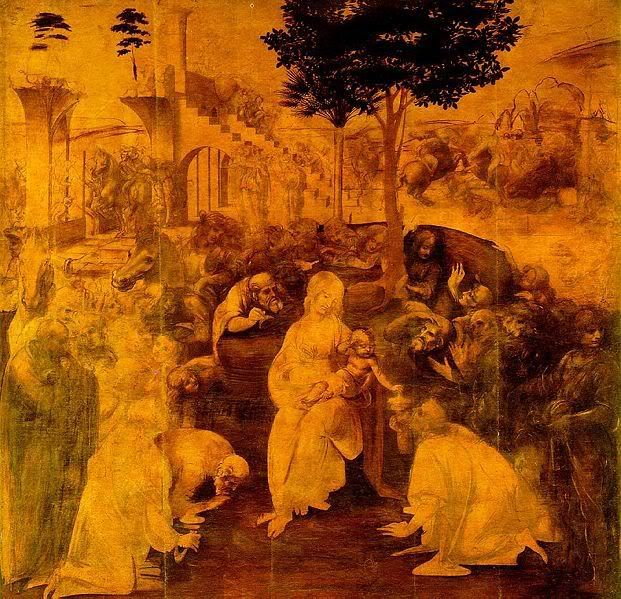
There isn't a single striking thing about it. But, if the interpretations are to be believed, a brazenly atheistic da Vinci (who would, at the time, have been about 29--not actually very young at all, and probably considered 'middle aged' or even older for the time) placed a subtle jab at the monks for whom he was working. Purportedly he wasn't terribly happy with the project in the first place--he didn't enjoy religious subjects and didn't like having to spend time around monks--but grudgingly took it for the money. Following some dispute or other with the abbot, he let off a little steam with a little hidden thumb-to-the-nose at not only the Augustinians but also possibly to the Church itself--even though, as insults go, few are more obvious than leaving their painting unfinished and decamping for another city.
Look to the right. The far right, just near the edge. About halfway down. The last young man there on the right. Do you see him?
Right here:
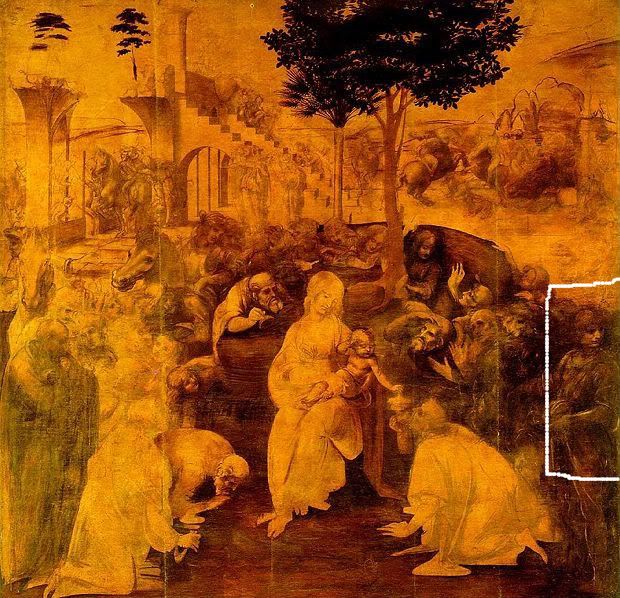
Take a look at him, notice what he's doing. Or, more accurately, notice what he isn't doing.
He is the only (human) person in the painting not looking at the Christ-child. While everyone else fawns and grovels and kisses his feet, the man on the right's attention is elsewhere. He's not just not looking at Jesus--he's looking completely the other way all together. He even looks just the slighted bit smug, and almost like he's getting ready to make his escape and was caught in the frame just as he was going to leave.
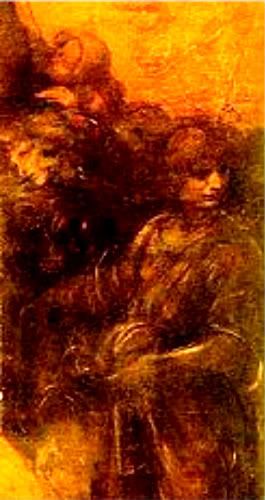
There is, naturally, no way of knowing for certain so any interpretation of the piece is just that--interpretation--but it's believed that this is a secret self-portrait of the young da Vinci himself, cheekily showing the world that he couldn't be fucked to give a rat's ass about the baby Jesus. A quiet, but very visible, 'fuck you!' to at least the Augustinian abbot, if not the entire monastery and the Church and religion as a whole--all permanently preserved for the future.
What the real meaning--if any--of this unknown scoffer happens to be, we almost certainly will never know and scholarly discussions regarding him and every other brushstroke and pen-blot da Vinci and his contemporaries ever made will remain forever in open debate. Experts and amateurs alike will always have something to say about it and conclusions to confidently assert.
And whatever da Vinci believed himself, he certainly gives an interesting--if not altogether completely compelling--case one way with a silent jab at religion in one of his many, many paintings.
Tall Tales and Short Stories
My last semester at college before I dropped out, I was totally burned out and was trying to get myself excited about school again. So I took an extra elective instead of one of the core classes I needed as a 'treat', something I could have fun doing and that I'd look forward to. It didn't end up working out but I don't think I'll ever forget a couple of the 'creatively written' madness that everyone wrote. Since it was a base-level class without prerequisites, anyone could sign up for it and the talent displayed ranged from professional quality to truly atrocious.
On the Truly Atrocious side, my favourite contributor was a kid called Zack. He was a freshman and extremely, supremely socially awkward (almost one of the most awkward people I have ever met, and trust me, I've met some reeeeeeally socially awkward people). He was also immature, not terribly bright, and very arrogant--a combination that made him insufferable to talk to or deal with, and being as socially unaware as he was he couldn't understand that his input wasn't wanted in every conversation around him or that someone was uninterested in talking to him. (In before someone yells 'AUTISM!!'--he probably was but that isn't the point.) As a special bonus, he had terrible hygiene, and body odour so offensive that you could smell him no matter where you sat and on one particularly potent day a girl threw up.
He wrote several stories over the semester but the one that stands out in my mind was his first offering. It was the story of some samurai warriors (as written by an underinformed Japanophile) who shipwrecked on a lost forest island and become embroiled in an ongoing 'war' with the island's other inhabitants, cowboys and a tribe of Indians. The samurai had random Japanese words for names, the cowboys all given 'Billy the Kid'-type western-movie nicknames, and the Indians all seemed to have white-bread Anglo names. There were dinosaurs involved in the story, too, but I honestly don't remember how he fit them in or what purpose they served other than to turn up at the end and kill everyone with a combination of eating everyone and some weird random dinosaur kung-fu moves. I swear this is the whole story. His spelling and grammar were terrible and the whole thing was written really badly--every line of dialogue was emphasized with a long line of question marks or exclamation points (or both) and written in all caps.
If it were a parody of the adventure/fantasy genre, then it wouldn't have been this funny--heavy-handed, but a decent effort at ragging on cliches--but the fact that he was absolutely, totally, COMPLETELY serious about the whole thing and his earnestness came through in the way he wrote made it just so much worse. I'm usually loath to laugh at young writers whose technique is unpolished, but this wasn't unpolished. It was just plain BAD. And oh, it was glorious and beautiful and I wanted to start a religion around it. I seriously lament the fact that I never saved a copy for myself because it truly was a shiny golden turd. I'm glad we didn't read the stories in class (we emailed them and read them at home), because if we did then the laughter would have spoken for itself. No one could find anything genuinely nice to say about it other than a few token remarks about it being 'an interesting premise' and having 'potential'. No one was mean and the criticism was worded very carefully and very gently, but you could tell he was just totally shocked that we weren't fawning over him. I get the impression that he might have been, ahem, 'special' and that because of this any piece of work he produced was excessively praised and fawned over. He thought he was Michael Crichton. This with his arrogance (he really thought he was the shit--rather than just smelling like it) was a wonderful combination and the experience was probably pretty shocking to him. It was a long fall to earth.
He wrote other stories (including one where a guy gets his ass kicked by a group of kung-fu high school girls), but this was his greatest piece of fail I've ever read. It's even worse than Twilight.
Almost everyone else in the class was average to reasonably good, but one of my absolute favourites and one of the best-written was called 'Skeletons in the Closet'--I can picture the face of the girl who wrote it in my head but for the life of me I don't remember her name. It might have been Liz but I really don't know. It was a first-person story and the narrator was a woman whose husband has just been declared legally dead after being missing for five years. Then you find out it was her third husband and the story of her three courtships, three marriages, and the three husbands she murdered was amazingly funny dark comedy. It wasn't even in-your-face and deliberate (like mine is), but the subtlety combined with the almost disturbing calm nonchalance of the narrator made it eerie and hilarious at the same time. At the end, knowing that declaring her last husband dead would be the end of it, she reveals the skeletons in her closet--she's kept all three of them. she kisses them all on the head and welcomes them all home. IT WAS SO COMPLETELY TWISTED. But fabulous. I no longer have a copy of this one, either, but it remains one of my favourite short stories ever. Wherever that writer ended up, I hope she's still at it. Because it was genius.
Obviously it was more than just a handful of people in the class so there were a good many others over the semester but these two are the ones that stand out the most. Maybe I should look into the community college here and just take a creative writing class. It might be fun, and who knows--maybe I'll find the next Golden Turd.
Thursday, January 5, 2012
I Find Competence Elusive
I forgot my name the other day.
Really, I mean I just completely forgot my name. I was at the bank cashing a check, and when I went to sign the back of it and accessed the part of my brain where pertinent information is stored—like my name and my address and exactly how many of my parents are still living—I basically ended up with the neural equivalent of ‘404 Error’. You know how in old western movies they always have a shot of a barren desert, and the only movement comes from a lone tumbleweed blowing across the frame? That’s how it felt.
Fortunately—inasmuch as the word can apply here—I had the presence of mind to pretend I couldn’t remember my account number so I at least didn’t look like a total nutbag in front of the teller. In the end I got it all sorted out but I must blushingly confess that I had to look at my driver’s license to jog my memory. I got everything I needed to do done and I even remembered to take my purse with me when I left (I’m a fiend for leaving my purse behind in places, even though it’s roughly the dimensions of a Boeing), and I went about the rest of my day as normal and didn’t really think of the incident again.
And actually, that’s what I find so troubling about the whole thing—that it didn’t really occur to me to be concerned about it at all. The most worrisome part isn’t that I forgot my name to begin with, but the fact that forgetting my own name didn’t even register as at all unusual or cause for alarm. To be perfectly frank, it really isn’t. This kind of thing happens to me all the time.
I’m not an especially successful adult. I hesitate to call myself an ‘adult’ at all—I come under the category of grown-up only by virtue of a few technicalities, much in the same way a Chihuahua counts as a ‘dog’ despite the fact that it’s taxonomically more consistent with members of the rodent family, or is possibly some kind of furry bug-eyed beetle. Speaking personally, I have only two traits that mark me as an adult: I am over the age of eighteen, and, despite all of my efforts to stop it, am in possession of a set of fully functional reproductive organs. Other than that, I remain astoundingly immature and childish. I have all the sense of responsibility and maturity of a rhesus monkey, and display roughly the same level of awareness of my surroundings as a fish stick.
Add to this the fact that I am both extremely forgetful and absentminded, to such an amazing extent so as to seriously suggest some kind of legitimate mental deficiency on my part. And I don’t mean my mind wanders or I forget where I left my sunglasses—although both of these do happen to me, and frequently—but I will completely forget where I put something just seconds after putting it down. There are very few things I can remember with anything like reliability, and I’m constantly having to stop and really think about things that should be second nature, like exactly what year I was born in and what planet I come from. A weekly ritual for me consists of finding a landline telephone—in and of itself a challenge—and then using it to call my cell phone so I can hear it ring, because I can’t remember where I put it, inevitably resulting in a whole afternoon playing a high-tech game of Marco Polo. I once spent an entire day frantically looking for a favourite bracelet I’d misplaced; I retraced my steps and called every store I went to that day to see if anyone had found it, to no avail. Heartbroken, I went to bed that night accepting that I had probably lost it for good—only to find it in my bra, exactly where I’d put it hours earlier to wash my hands.
I frequently forget entire, lengthy conversations with people who are important to me—like my boss or my boyfriend—putting me in the absurd position of having to be reminded of everything I said and agreed to, as well as having to take someone else’s word for the fact that the conversation even occurred at all. I’m very fortunate that no one in my life is an asshole, because I could very easily be convinced that I had a conversation that never happened and agreed to things I’d never even considered.
Even on a good day, I have at best a tenuous grasp of reality and the world around me. It’s not unheard of for me to miss things that other people would find quite startlingly obvious. It really is extremely difficult to overstate my level of obliviousness. When my dad got a new car several years ago, it was months before I even noticed—despite the fact that it was parked in the garage, I saw it every day, and it was a completely different make and colour than the old one. I’m not talking a subtle change of colour, either, like a dark blue car to a black one. No, the old car was ultramarine blue and a station wagon, and the new one was a silver sedan. This happened six years ago and I am still occasionally surprised to find that the blue car isn’t there anymore.
Just in case there was any doubt in anyone’s mind about me, this is my ultimate accomplishment of absentmindedness. In my life I have experienced three—three!!—earthquakes. All three times I completely failed to notice that anything unusual had happened. The epicenter of one of these quakes was just two miles from my house and actually split open the road, so these were not insubstantial little rattles. And yet in all three cases I found out much later from outside sources that the ground had actually shaken beneath my feet, arguably a considerable change from the norm, and yet I had no idea it had happened at all. At this point, I’m reasonably sure that someone could land a helicopter in my bedroom and I wouldn’t even notice. For all I know this could have happened already, and there could really be a helicopter in here and I just haven’t figured it out yet.
I know there’s no hope for me to keep my head on my shoulders, so these days I just try to be at least broadly aware of where I am and what I’m doing. Enough to keep me from taking any more of those accidental, unplanned excursions over the state line while absently thinking of bubblegum and napalm. (This might or might not have really happened to me—I said something very similar to this to a friend, who then asked quite seriously if it was true. The fact that I can mention a scenario so overtly absurd and it still sounds like something I would actually do speaks volumes.)
So this is what I have to work with. I am not, in short, a person to whom any amount of mental sharpness comes naturally. Most of this seems to completely preclude being a proper grown-up, and yet at the age of eighteen and despite all of my obvious mental shortcomings, I was handed over complete and total control of every aspect of my life as if this was something I had any capacity to understand or appreciate. It’s like giving over control of a Space Shuttle launch to a six-year-old—it can only end badly and will probably involve large-scale destruction and a fiery explosion.
I do actually remember the very first thing I did on my eighteenth birthday as an Official Adult. I bounded downstairs, confronted my mother, and declared gleefully, “Guess what, Mom! I am my own adult supervision now!” Whereupon she and everyone else who knew me and was aware of my proclivity for absentmindedness and making radiantly unwise decisions made a secret pact to be dead before I was old enough to have control of the country.
And then I went outside to play with matches, because I fucking could.
Actually, I’m not being completely fair to my brain. It is capable of holding onto information and doing so for a very long time, but unfortunately it seems to have come to exactly the wrong conclusions about what is worth holding onto. Despite being completely unable to remember my date of birth or what kind of car I drive, I can still tell you the mascot of every school I ever went to (the Aspen Owl, the Daly Bulldog, the Neelsville Knight, and the WMHS Wolverine); I know the shortest term ever spent in office by a US president (William Henry Harrison, who celebrated his inauguration by contracting pneumonia and dying in thirty days); I remember the name of the girl at school who used to try to pick me up every time she saw me (Rachel), and the woman who babysat me when I was three and my parents both worked (Lou-Anne). If I walk into a room I stand only about a fifty percent chance of remembering what I went in there for, and I can’t remember if my middle name has an ‘e’ at the end of it or not, but I can remember advertising jingles for products that have not been on the market in more than fifteen years.
Thinking about it, though, I don’t know that I’m completely alone in this. I think a lot of people forget really important things but remember totally useless shit. I bet if you survey a thousand average Americans, less than a third of them could tell you who was president when they were born or name any more than one or two Supreme Court justices, but every last one of them would be able to hum the Jeopardy tune and recite the lyrics to the ‘Gilligan’s Island’ theme song.
Go ahead. Do it. I’d do it myself but I can’t remember where I left my cell phone.
Tuesday, January 3, 2012
What We Hold Dear
(Somewhat related to this post about the familiarity of the graffiti found in Pompeii.)
I said it before, and I'll say it again: people don't really change. Not only that, but we're all here NOT CHANGING in exactly the same ways. We really are all very much alike, a sentiment bandied around since the feel-good 60s to promote tolerance--possibly because, when you're THAT fucking high, you can no longer remember or recognize any of the people around you so why the hell NOT treat them all like friends? Even if it turns out you didn't even know them, you do now!
Without opening a can of worms here, current popular opinion gives people an automatic, unconscious negative reaction to hearing about countries and people in the Middle East. The way it's talked about, it's like we're two different species. And while we do have seemingly irreconcilable differences in the social, religious, and political we hold the fact still remains that WE AREN'T DIFFERENT.
I found a series of photos called 'Things People Carry', which is essentially asking total strangers if it's okay to take pictures of the contents of their purse or pockets or bags or briefcases. This particular set--155 photos in all, so be warned if you have a slow connection--comes from Iran. The things you carry with you, on you, every day--the things you wouldn't leave home without--are pretty personal. Here's the thing though. Except that it's all in Arabic, IT COULD BE THE STUFF YOU HAVE IN YOUR BAG RIGHT NOW. Money, keys, and credit cards; makeup, medicine; notebooks, pens and pencils, books, and glasses; cell phones, iPods, smart phones; gum, candy, snacks, CDs, and tissues. Even an iPad with an anime-style desktop image.
These are not foreign items. These aren't things we don't recognize. These are the same things people in the West and Asia and the Americas carry with them every day. I probably have weirder things in my bag than any of these 155 people did.
People like to point out that under our skin we all look exactly the same but you don't even have to go that far. Just turn out your pockets. You have more in common with everyone else in the world than you realize.
Subscribe to:
Posts (Atom)